By ChinaPeptides Technical Team · Published April 8, 2026 · 8 min read
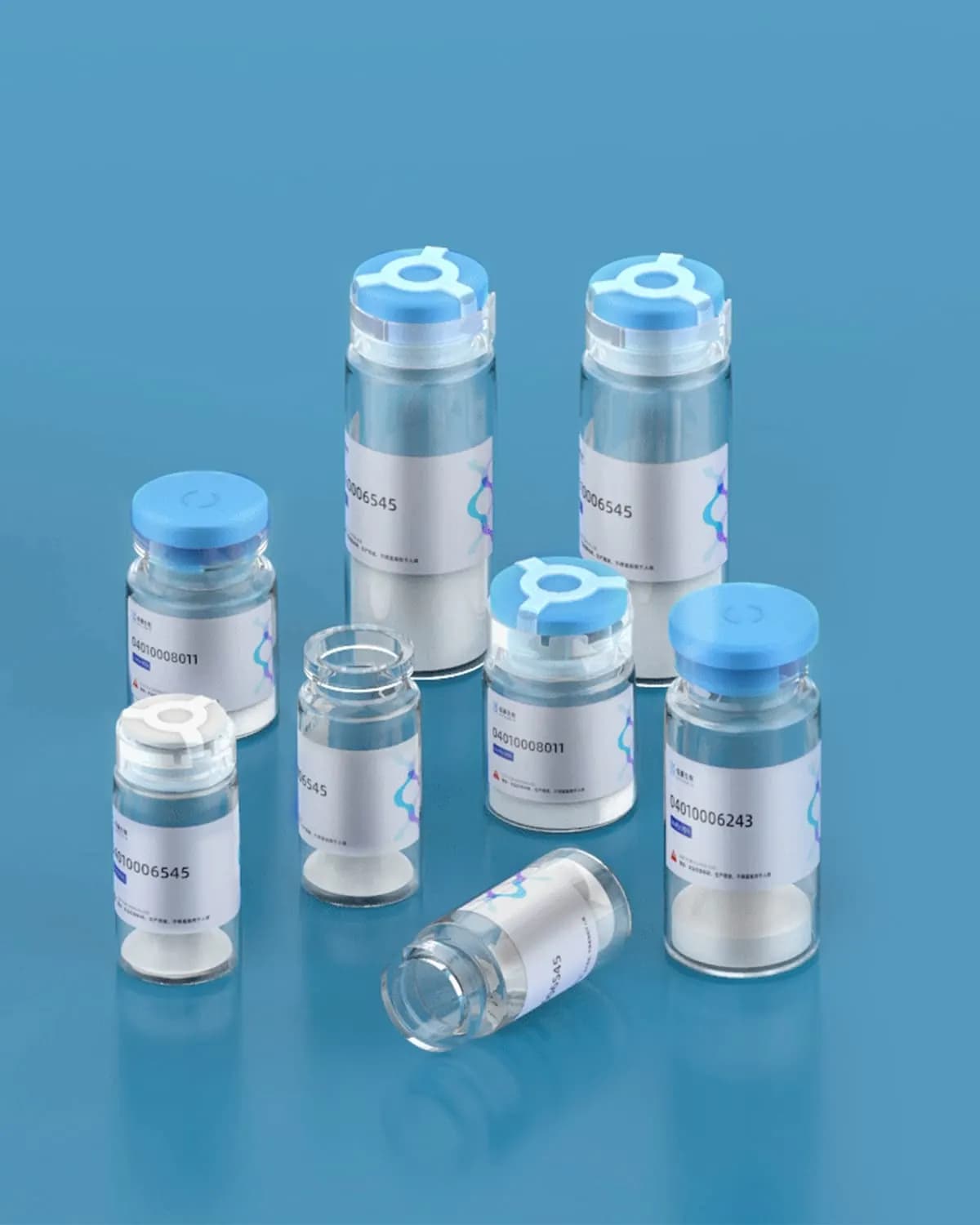
Custom peptide synthesis is the manufacture of a defined amino-acid sequence to a written specification, not the purchase of a named catalog lot. For a research group, the useful output is a lyophilized solid whose identity, HPLC purity, and salt form can be checked against a certificate. For the manufacturer, the same request is a route decision: resin, protecting-group scheme, coupling conditions, cleavage, purification, and analytical release.
ChinaPeptides treats custom peptide synthesis as a project, not a warehouse pick. The sequence you submit is evaluated for length, hydrophobicity, residues that rearrange or oxidize, and any modification that changes the chemistry. This guide walks through that evaluation so you can write a specification that is complete enough to quote and tight enough to use in an assay.
What a custom lot actually contains
A delivered peptide is a mixture. The main component is the intended chain. The remainder is a combination of deletion and truncation sequences, incompletely deprotected material, residual scavengers, water, and counter-ions from purification. HPLC area percent describes only the UV-active peptide-related species in the injected sample. It does not state how much of the vial weight is peptide versus trifluoroacetate or residual solvent.
That distinction matters when you dissolve a weighed aliquot and calculate molarity. Two lots at the same HPLC purity can give different effective concentrations if net peptide content differs. If your experiment is concentration-sensitive, ask for peptide content or plan an independent assay rather than assuming the label milligrams are 100% peptide.
Most research peptides are supplied as the TFA salt after reverse-phase purification. Acetate or hydrochloride exchange is a separate step and should be requested when TFA is incompatible with cells, NMR, or a downstream conjugation. Salt form is part of the specification, not an afterthought on the packing list.
Information chemists need before a quote is real
A sequence string is necessary but not sufficient. A complete inquiry states N- and C-terminal status (free, acetyl, amide), desired HPLC purity, quantity as net peptide or as lyophilized solid, salt preference, and every modification with its attachment site. If the peptide is intended for immunization, a cysteine or linker for carrier conjugation should be explicit. If it is intended for mass-spectrometric quantification, isotope labels belong in the same request, not in a later email.
Ambiguous notation causes the largest delays. Write non-canonical residues with a recognized three-letter or common code and name the protecting group if one must remain. Mark disulfide pairings if more than two cysteines are present. For fluorescent or biotin labels, say whether the dye sits on the N-terminus, a specific lysine, or a C-terminal lysine added for that purpose. The design notes for a custom peptide cover the same checklist from the experiment side.
Quantity should match the experiment plus a reserve for a second weighing and a confirmation HPLC if you run one in-house. Ordering 1 mg when the assay consumes 800 µg leaves no room for a failed reconstitution. Ordering 50 mg when you need 2 mg wastes purification capacity on a grade you may not need. Scale and purity interact: a 5 mg lot at ≥98% is a different purification problem than 100 mg at ≥95%.
How the synthesis route is chosen
Nearly all research peptides of typical length are assembled by solid-phase methods, most often Fmoc chemistry. The chain grows from the C-terminus on a resin. Each cycle removes the temporary N-protecting group, couples the next residue, and washes away excess reagent. After the final residue, the peptide is cleaved from the support and side-chain protecting groups are removed, usually in strong acid with scavengers chosen for the residue set.
Route changes appear when the sequence is long, aggregation-prone, or densely modified. Difficult couplings may use more reactive activators, double coupling, or pseudoproline dipeptides. Very long chains may be split into fragments and joined in solution or by ligation. Cyclic, stapled, and multiply labeled peptides add orthogonal protection and extra isolation steps. Those cases are still custom synthesis; they are not a different product line with different identity rules.
If you already know the chain will be long or poorly soluble, read the companion notes on long peptide assembly and difficult sequences before you lock the sequence. Changing one hydrophobic stretch or adding a charged residue is often cheaper than forcing a failing linear route.
Purity, salt, and analytical release as specification items
HPLC purity is a method-dependent number. The same lot can look cleaner or dirtier if the gradient, ion-pair reagent, or detection wavelength changes. A usable specification names a minimum area percent under a described method, not a slogan such as “high purity.” Common research grades are crude (cleaved, little or no HPLC), ≥70–80% for some immunization work, ≥95% for many binding and cell assays, and ≥98% when a close-eluting impurity would confound interpretation.
The purity selection guide maps those grades to experiment types. The short version: do not buy ≥98% for a first immunization screen, and do not use crude material in a quantitative biochemical assay. If you are unsure, describe the readout (ELISA, SPR, NMR, live-cell imaging) rather than guessing a percentage.
| Specification item | Why it belongs on the order | Typical research default |
|---|---|---|
| Sequence and termini | Defines the molecule and the first residue chemistry | Free N-terminus, amide or acid C-terminus as designed |
| HPLC purity | Sets purification effort and impurity risk | ≥95% for most in vitro assays |
| Quantity | Determines scale, yield pressure, and price | Experiment use plus a reserve aliquot |
| Salt form | Affects solubility, NMR, and cell tolerance | TFA unless another salt is required |
| Modifications | Change protection, cleavage, and isolation | None, unless the assay needs a handle |
| Analytical package | Tells you what the CoA will prove | HPLC plus MS for identity |
Identity is confirmed by mass spectrometry. A matching monoisotopic or average mass supports the intended formula; it does not prove sequence order by itself. HPLC shows that one main species dominates the UV trace. Together they are the minimum release pair for a research lot. Additional tests—amino-acid analysis, residual solvent, endotoxin—are project-specific and should be named if a protocol requires them. ChinaPeptides documents the tests that were actually run on peptide quality control pages and on the lot certificate.
Modifications that change more than a drawing
A biotin, fluorophore, PEG chain, or disulfide is not a sticker applied after a linear peptide is finished. Many labels are introduced with a protected building block or by a selective reaction after cleavage. The site of attachment, the linker length, and the residual reactive groups all belong in the design. A dye on a lysine that is also needed for activity is a different molecule from a dye on an extra C-terminal lysine.
Cyclization, stapling, glycosylation, and lipidation each add a chemical chapter. If modification is the reason you are ordering, start from the peptide modification service description and then return to this specification list. The synthesis quote should name the chemistry, not only the desired structure.
Scale, yield, and what “mg” means
Quoted quantity is the amount intended for delivery after purification, not the theoretical yield from resin loading. Difficult sequences lose material at coupling and again on the HPLC column. A request for 10 mg of a 40-residue hydrophobic peptide at ≥98% may require a larger crude batch than the same request for a soluble 12-mer. If the first purification cut is short, a manufacturer may resynthesize rather than ship an underweight vial. That is a project conversation, not a shipping error.
Crude or desalted material is appropriate when you will purify yourself or when a polyclonal immunization tolerates related sequences. It is a poor choice when the next user expects a single peak. State the intended use so the quote does not optimize the wrong variable.
When a catalog peptide is the better first step
If the sequence is a widely studied hormone, epitope tag, or antimicrobial fragment, a catalog peptide lot may already exist at a documented purity. Catalog material is still research-use only and still needs the same storage and reconstitution discipline. It is not custom if you cannot change termini, labels, or salt form. Use catalog stock to test an assay; move to custom synthesis when the sequence or modification is yours.
How to place a request that can be manufactured
Write the sequence in amino- to carboxy-terminal order. List modifications under the residues they attach to. Give purity as a minimum HPLC area percent. Give quantity in milligrams. Name the assay class if purity is uncertain. Attach a literature sequence only if you have checked the termini and disulfide pairing against the original paper. Then send the package through a synthesis quote request so the chemists see one document rather than a trail of chat messages.
All peptides discussed here are intended for laboratory research. They are not diagnostic reagents, drugs, or materials for administration to humans or animals as therapy.
Frequently asked questions
How long does custom peptide synthesis take?
Simple linear peptides of typical length are often in the range of one to three weeks including purification and analysis. Long, cyclic, or multiply modified sequences take longer because extra chemistry and isolation steps are required. A quote should state a planned window, not a guaranteed calendar day, because difficult couplings can force a repeat synthesis.
Is HPLC purity the same as peptide content?
No. HPLC purity is the area percent of the main peak among species detected in that chromatogram. Peptide content is the weight fraction of the solid that is peptide rather than water and counter-ion. Use both numbers if you need an accurate molar concentration from a weighed sample.
Do I need ≥98% purity for every experiment?
No. Many binding and immunization experiments are interpreted safely at ≥95%. Higher purity is justified when a close-eluting impurity would change the readout or when the peptide is a quantitative standard. Match the grade to the assay rather than defaulting to the highest listed number.
Can I change the sequence after the quote is accepted?
A sequence change is a new molecule. Protection, coupling difficulty, and purification all reset. Treat a redesign as a new inquiry so the route and price stay aligned with the chemistry.
What if my peptide contains more than two cysteines?
State the intended disulfide pairings. Without that map, oxidation can produce a mixture of isomers that HPLC may not fully resolve. Pairing is part of the structure, not an optional note.
Will I receive a chromatogram and a mass spectrum?
A standard research CoA includes HPLC purity of the released fraction and a mass measurement that supports the expected molecular weight. Ask in the inquiry if you need the raw traces attached, not only the tabulated values.
Are custom peptides for research use only?
Yes. ChinaPeptides manufactures peptides for scientific research. They are not intended for diagnostic, therapeutic, or other human use.